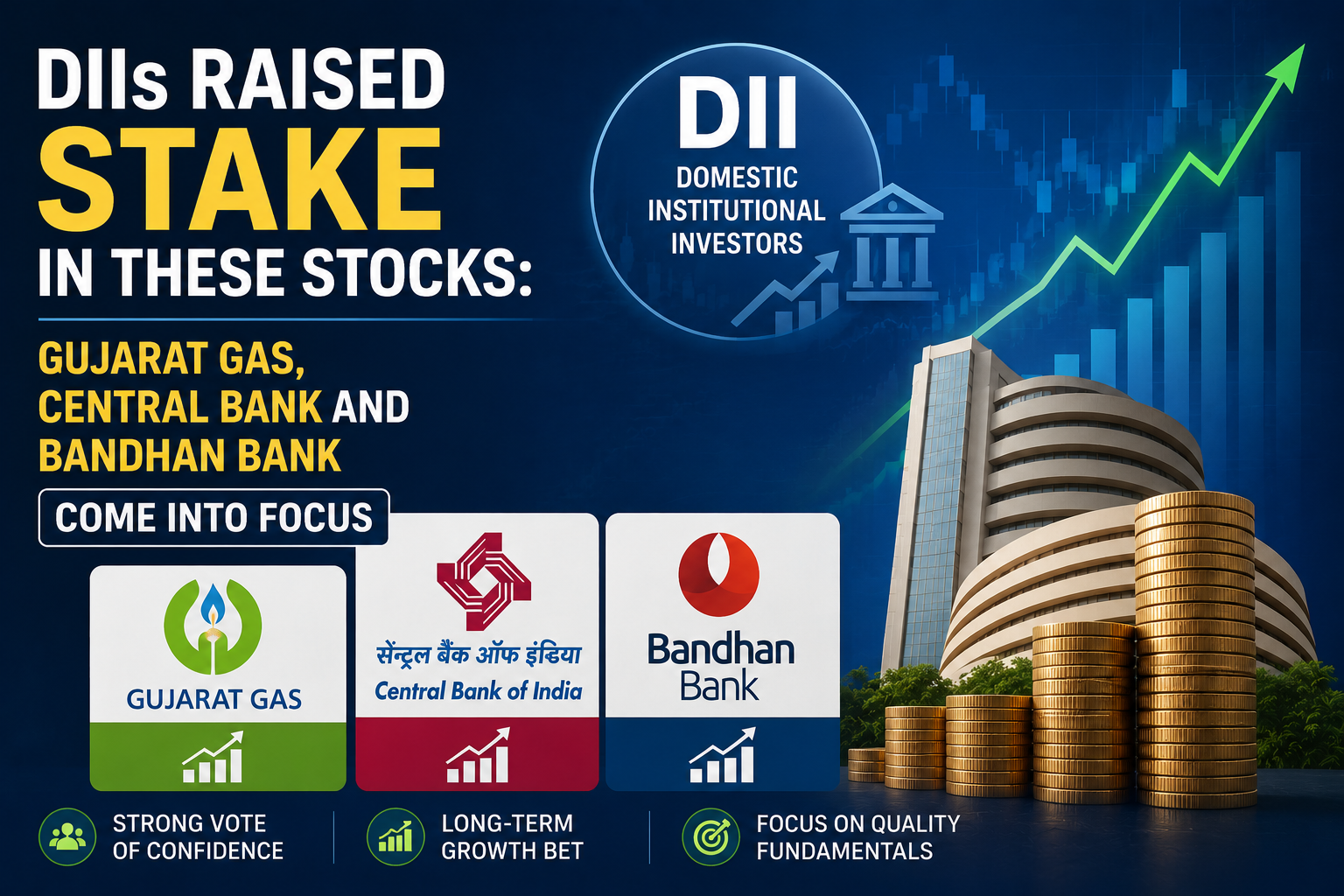
DIIs Raised Stake in These Stocks: Gujarat Gas, Central Bank and Bandhan Bank Come Into Focus
DIIs Increased Stake in These Stocks: Why Investors Are Tracking Them
When Domestic Institutional Investors, or DIIs, increase stake in a company, the stock usually comes on investors’ radar. DIIs include mutual funds, insurance companies, banks and other Indian institutions.
The reason is simple. Institutional investors generally study business performance, valuations, sector outlook, management commentary and future earnings potential before increasing exposure.
As per shareholding data available on Screener, Gujarat Gas and Central Bank of India saw a sharp rise in DII holding in May 2026. Bandhan Bank also saw a strong increase in DII stake in the latest available data.
This does not mean these stocks are automatic buys. But it does make them worth tracking.
Quick Data: DII Stake Increase
| Stock | Sector | Previous DII Stake | Latest DII Stake | Increase |
|---|---|---|---|---|
| Gujarat Gas | City Gas Distribution | 14.76% in Mar 2026 | 24.64% in May 2026 | +9.88 percentage points |
| Central Bank of India | PSU Banking | 4.82% in Mar 2026 | 10.82% in May 2026 | +6.00 percentage points |
| Bandhan Bank | Private Banking | 18.76% in Dec 2025 | 22.33% in Mar 2026 | +3.57 percentage points |
Note: Gujarat Gas and Central Bank of India show DII stake increase in May 2026. Bandhan Bank’s latest available data shows DII stake increase up to Mar 2026.
1. Gujarat Gas: Biggest DII Stake Jump Among These Names
Gujarat Gas saw a sharp rise in DII holding in May 2026. The stake moved from 14.76% in Mar 2026 to 24.64% in May 2026, a jump of 9.88 percentage points.
That is a strong institutional signal.
Gujarat Gas is one of India’s major city gas distribution companies. It supplies CNG and PNG to domestic, industrial, commercial and non-commercial customers. The company has a strong presence in Gujarat, Saurashtra and other key markets.
Why Gujarat Gas Is in Focus
The company is linked to India’s long-term natural gas consumption story. If India’s gas usage increases over time, city gas distribution companies can benefit.
Key triggers include:
- Strong CNG and PNG network
- Industrial gas demand recovery
- Long-term clean fuel adoption
- Institutional buying in May 2026
- Reasonable valuation after correction
Gujarat Gas also reported FY26 sales of ₹23,614 crore and net profit of ₹1,678 crore.
Key Risk
The biggest risk is margin volatility. Gas companies depend on input gas prices, industrial demand and pricing power. If gas cost rises sharply, margins can come under pressure.
2. Central Bank of India: PSU Bank With Sharp DII Buying
Central Bank of India also saw a strong rise in DII stake in May 2026.
DII holding increased from 4.82% in Mar 2026 to 10.82% in May 2026. That is a rise of 6.00 percentage points.
This is important because PSU banks have remained a strong market theme. Many public sector banks have improved asset quality, reduced stress and delivered better profitability in the last few years.
Why Central Bank Is in Focus
Central Bank of India is being tracked for three reasons.
First, PSU banks are still benefiting from sector rerating. Second, improved balance sheets have made many PSU banks more attractive to investors. Third, the rise in DII holding shows institutional interest.
Key triggers include:
- PSU banking rerating theme
- DII stake increase in May 2026
- Improving return ratios
- Better asset quality across PSU banks
- Possible value unlocking over time
Central Bank’s ROE has also improved in recent years, with ROE at 12% in Mar 2026.
Key Risk
Banking stocks depend heavily on asset quality. Investors should track gross NPA, net NPA, credit cost, loan growth and net interest margin.
If credit costs rise again, PSU banking stocks can become volatile.
3. Bandhan Bank: DII Stake Rose in Latest Data
Bandhan Bank is a private sector bank and a turnaround candidate.
In the latest available shareholding data, DII holding increased from 18.76% in Dec 2025 to 22.33% in Mar 2026, a rise of 3.57 percentage points.
Bandhan Bank has been under pressure in recent years because of asset quality concerns, especially in microfinance and certain borrower segments. But when a stressed bank starts showing signs of stabilisation, institutional investors often begin tracking it again.
Why Bandhan Bank Is in Focus
Bandhan Bank is not a simple growth story. It is more of a recovery story.
Key triggers include:
- DII stake increase in latest data
- Turnaround expectations
- Asset quality recovery hopes
- Focus on secured loan book
- Capital plan review by board
- Appointment of Debasish Panda as Non-Executive Chairman from July 5, 2026
Key Risk
Bandhan Bank’s biggest risk is asset quality. If stress rises again in microfinance or unsecured loans, the stock may remain under pressure.
Investors should track credit cost, GNPA, NNPA, deposit growth and loan book mix.
Why DII Buying Matters
DII buying is useful because it shows institutional interest. But it should not be treated as a direct buy signal.
A rise in DII holding can mean:
- Institutions see valuation comfort
- Business outlook is improving
- Sector sentiment is turning positive
- Stock has entered institutional radar
But DIIs can also reduce stake later. So, investors should use this data only as a starting point.
Which Stock Looks Most Interesting?
Among these three, Gujarat Gas stands out because it is from a non-banking sector and saw the sharpest DII stake increase in May 2026.
Central Bank of India is a PSU banking play. It may remain in focus if PSU bank sentiment stays positive.
Bandhan Bank is a higher-risk turnaround stock. It can do well if asset quality improves, but it needs closer tracking.
In simple terms:
- Gujarat Gas: city gas distribution theme
- Central Bank: PSU bank rerating theme
- Bandhan Bank: private bank recovery theme
Key Risks Investors Should Know
1. DII Buying Can Reverse
Institutions can buy in one period and sell later. Investors should track holding trends over multiple quarters.
2. Valuation Risk
If a stock rises sharply after DII buying, valuation may become expensive.
3. Sector-Specific Risk
Gujarat Gas depends on gas prices and industrial demand. Central Bank depends on asset quality and credit growth. Bandhan Bank depends on recovery in stressed loan segments.
4. Data Interpretation Risk
A rise in DII stake should be read carefully. Sometimes shareholding changes happen due to large deals, classification changes or corporate actions.
Final Takeaway
DII activity can help investors identify stocks that are gaining institutional attention.
In May 2026, Gujarat Gas and Central Bank of India saw sharp DII stake increases. Gujarat Gas DII holding rose by 9.88 percentage points, while Central Bank’s DII holding rose by 6.00 percentage points.
Bandhan Bank also saw DII holding increase by 3.57 percentage points in the latest available data.
These stocks are worth tracking, but investors should not buy only because DIIs increased stake. The better approach is to check business fundamentals, valuation, earnings outlook and risks before making any decision.
FAQs
What is DII in stock market?
DII means Domestic Institutional Investor. It includes mutual funds, insurance companies, banks and other Indian institutions investing in the stock market.
Which stocks saw DII stake increase in May 2026?
Gujarat Gas and Central Bank of India saw DII stake increase in May 2026.
How much did DII stake increase in Gujarat Gas?
DII holding in Gujarat Gas increased from 14.76% in Mar 2026 to 24.64% in May 2026, a rise of 9.88 percentage points.
How much did DII stake increase in Central Bank of India?
DII holding in Central Bank of India increased from 4.82% in Mar 2026 to 10.82% in May 2026, a rise of 6.00 percentage points.
Did DII stake increase in Bandhan Bank?
Yes. In the latest available data, Bandhan Bank DII holding increased from 18.76% in Dec 2025 to 22.33% in Mar 2026.
Should investors buy stocks because DIIs increased stake?
No. DII buying should be used as a research signal only. Investors should check valuation, financials, business outlook and risk before investing.
Source Note
Shareholding and financial data used in this article is based on Screener company pages for Gujarat Gas, Central Bank of India and Bandhan Bank.
Disclaimer
This article is for educational and informational purposes only. It is not investment advice or a buy/sell recommendation. Stock market investments are subject to market risks. Please consult a SEBI-registered investment advisor before making investment decisions.
Share this insight
Spread the Alpha
Related Articles
More ideas that align with your trading playbook.
This PSU Stock Jumped 32% in a Week. Here’s Why NIACL Shares Are Rallying
The New India Assurance Company, or NIACL, suddenly became one of the hottest PSU stocks in the market last week. NIACL shares…

5 gainers and losers on NSE today 9th April – Should you trade them tomorrow?
9th April 2025 – Flagship index Nifty closed 126.35 points lower ending the day at 22504. Binani Industries Limited (BINANIIND) was among…

8₹ Telecom stock with high retailer holding gains 30% in 3 days- Check why
Vodafone Idea (Vi) traded under code NSE:IDEA and BOM: 532822 (BSE) is currently trading near its 2 year low of ₹5.8. The…

 DailyBulls (Arthashilpi Ventures) is a D-U-N-S verified company.