
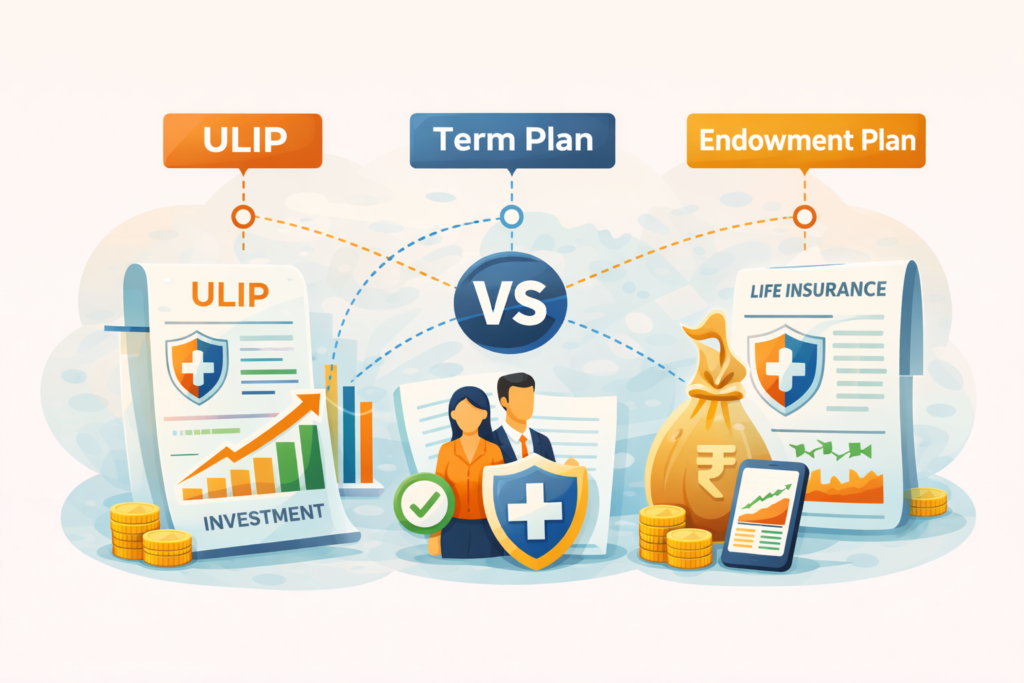
Deciding on an appropriate life insurance plan is important to achieve long-term financial goals & ensure financial security. Amongst multiple life insurance plans available, there are three most renowned plans, namely, ULIPs, term plans, & endowment plans. All plans come with their own attributes, which cater to different requirements of an individual, like life coverage, assured returns, investments, etc. On one hand, ULIPs provide dual benefits of insurance & market-linked investments, term plans offer life insurance coverage at a reasonable premium cost, & endowment plans provide assured payouts.
What is ULIP?
A Unit Linked Insurance Plan is one of the types of life insurance which includes two components, namely insurance & investment. Unlike term insurance, ULIP offers a part of the premium to be allocated towards life insurance & the remaining towards investment. One can opt to invest in debt, equity, or both, depending upon the level of risk &your objectives, making it an ideal investment option. It provides a flexible option to switch between the funds anytime during the policy tenure. In case of the policyholder’s death, the nominees will receive the return on investment or the amount of sum assured, whichever is higher, & if the policyholder survives the policy, they will receive the fund value.
What is a Term Plan?
A Term plan is the most common type of life insurance plan, which offers financial security to the family members if the policyholder dies unfortunately. This plan provides death benefits to the nominees of the policyholder in case of their death, hence offering financial protection. The policyholder gets financial coverage over the insured’s life in exchange for the premium paid. But, there is no maturity benefit in case of the policyholder’s survival.
What is an Endowment Plan?
An endowment plan is a kind of life insurance plan which includes a lump sum payment either on the policyholder’s death or maturity of the plan. It best suits those who are futuristic & want to look for long-term investment options & are planning for some future events, such as their retirement, their child’s marriage, etc.
Differences between ULIP, Term Plan, & Endowment Plan
Provided are the differences between ULIP, term plans & endowment plans:
| Point of Difference | ULIP | Term Plan | Endowment Plan |
| Type | This plan offers dual benefits of insurance & investment, where the premium is allocated towards both. | This kind of life insurance plan is the cheapest amongst all, offering coverage for a certain period. It is a pure financial protection plan, which offers financial security to the family members in case of the sudden demise of the policyholder. | This plan is a kind of life insurance plan that offers death & maturity benefits. It also includes accidental death riders, disability riders, etc. |
| Flexible | These are the most flexible amongst the three. This is because they allow switching between the funds depending on the financial needs. | This plan does not offer any flexibility because it only offers financial protection. | It is flexible up to a moderate level. |
| Lock-in Period | The minimum lock-in period under this plan is 5 years. | There is no lock-in period under this plan. | The lock-in period under this plan depends on the premium payment tenure, ranging between 2 to 3 years. |
| Transparency | It I the most transparent plan in terms of tracking the investments. | It does not offer transparency as the premium is allocated towards a common corpus. | It does not provide any transparency in the plan. |
| Returns | The risks involved range from low to high, depending on the allocation of funds & the market’s performance. | The regular term plans do not offer returns. Under term plans with return of premium, the total of the premium amount paid is returned in case the policyholder survives the plan. | This plan offers assured returns. |
| Premium | The premium amount depends on the amount of sum assured & the money invested. It remains the highest amongst all. | The premium amount is generally lower because it only offers death benefits. | The premium charges are high as they include life insurance & a savings component. |
Which Plan to Choose – ULIP, Term Plan or Endowment Plan?
The decision to choose between ULIP, term plan, or an endowment plan depends on financial objectives, risk tolerance level & investment horizon.
- Choose ULIP if:
- You want dual benefits of insurance & investments.
- You are willing to accept risks for higher ULIP Returns.
- You want to have a longer investment horizon.
- You want to increase your savings with the help of tax exemptions.
- You want an added life insurance coverage for your loved ones.
- You are willing to invest in market-linked securities.
- You have medium to long-term financial objectives.
- Choose Term Plan if:
- Your priority is to provide financial security to family members in your absence.
- You want to get high coverage of life insurance protection at a reduced cost.
- You do not want a maturity benefit, because this plan only pays in case of your death & not if you survive the plan.
- You hold other investment plans; a term plan can be an appropriate choice to complete your financial strategy.
- Choose Endowment Plan if:
- You are looking for a secure, stable, & guaranteed return.
- You prefer both protection for family members & savings for their future requirements.
- You can pay a high premium amount, as this plan includes the benefits of both insurance & investment.
- You can save regularly to achieve your long-term objectives.
Conclusion
To conclude, all of them, namely ULIPs, term & endowment plans, come with different financial objectives, while letting you build a comprehensive portfolio. An individual should consider diversification of funds, maintain a balance between security, savings, & growth of funds. The choice between a term plan & an endowment plan will depend on your financial objectives, risk tolerance level, & investment horizon. You can also consult a financial advisor who will guide you to make an informed decision to well-aligned with your financial goals & budget.