
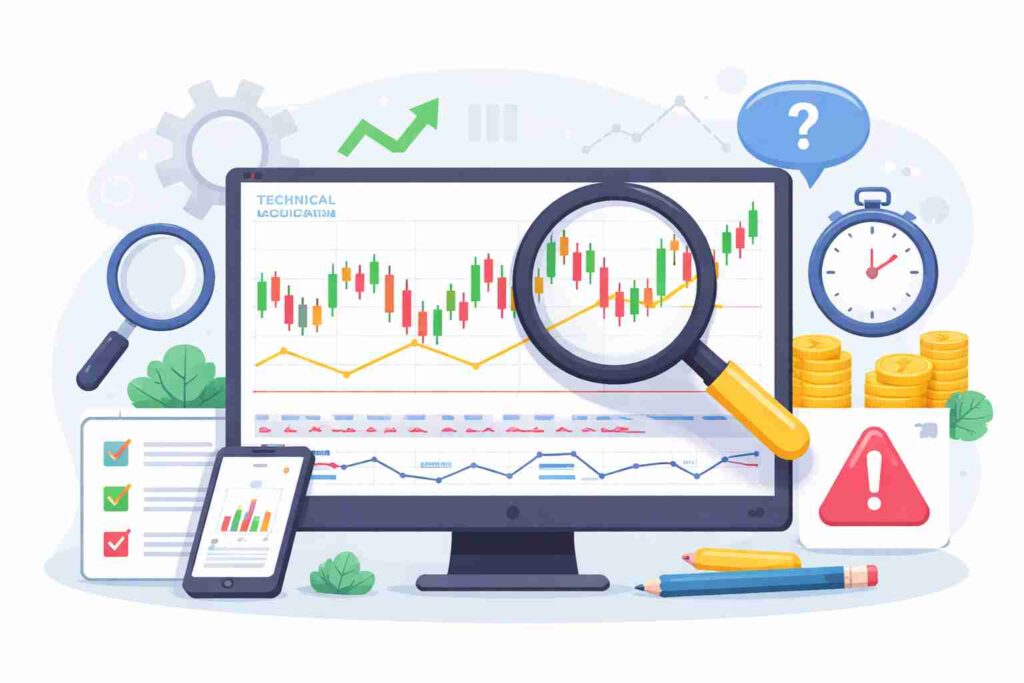
Technical indicators are tools traders use to interpret price action, spot trends, and time entries or exits. They’re displayed on price charts or in separate panels and are built from mathematical formulas applied to price and volume data. For beginners, indicators can feel like magic — but they work only when you grasp what they measure, how they interpret market behavior, and where they fall short.
What Technical Indicators Actually Measure
Indicators don’t predict the future — they quantify aspects of market behavior that your eyes might miss. Broadly, they fall into three categories:
1. Trend Indicators
These help you identify whether prices are moving up, down, or sideways.
- Moving Averages (MA): Smooth price data over a period (e.g., 20 or 50 days). A rising MA suggests an uptrend; a falling one suggests a downtrend.
- Average Directional Index (ADX): Measures trend strength — not direction. A low ADX means the market is range-bound, a high ADX suggests a strong trend.
Trend indicators reduce noise but lag price because they average past data.
2. Oscillators
Oscillators trade within a bounded range and help identify potential overbought or oversold conditions.
- Relative Strength Index (RSI): Ranges from 0 to 100. Traditionally, above 70 may signal overbought, below 30 may signal oversold.
- Stochastic Oscillator: Compares close price to a recent range, giving clues about momentum.
Oscillators highlight momentum changes but can mislead in strong trends.
3. Volume and Volatility Indicators
These assess the intensity of trading activity or how much price is varying.
- Volume: Increases confirm strong moves; low volume suggests weak conviction.
- Bollinger Bands: Measure volatility — tight bands suggest low volatility, wide bands suggest high volatility.
Volume and volatility indicators add context but don’t give direction by themselves.
Why Indicators Often Fail
Indicators are not trading systems; they are interpretive tools. Misuse or misunderstanding can lead to losing trades. Let’s break down common failure modes.
1. They Lag Price Action
Most indicators are based on past data.
For example, a moving average will only show a trend after it’s begun — often missing early price reversals.
2. Overfitting to Historical Data
When traders tweak parameters (like 14 periods, 21 periods, etc.) only to make indicators look perfect in the past, the result often performs poorly in live markets. This is known as curve fitting.
3. Misreading Oscillators in Trending Markets
Oscillators like RSI and Stochastics are designed for range-bound markets. During strong trends, these tools can remain in overbought/oversold zones for long periods, giving false signals.
Example:
- In a strong uptrend, RSI may stay above 70 for weeks — triggering multiple “sell” signals that never materialize.
4. Ignoring Market Context
An indicator doesn’t know news, economic data, or order flow. It treats all price action mathematically. Without understanding context — like earnings, macro trends, or liquidity events — indicator signals can mislead.
5. Using Too Many Indicators
Adding multiple indicators that measure the same thing (e.g., two trend indicators or two oscillators) rarely adds informational value. Instead, it can reinforce noise.
Best Practices for Using Indicators
Technical indicators are most useful when you treat them as filters or confirmation tools, not as standalone signals.
Choose Indicators That Complement Each Other
Combine:
- One trend indicator (e.g., moving average)
- One momentum/oscillator (e.g., RSI)
- One volatility or volume measure (e.g., Bollinger Bands or volume)
Avoid stacking four oscillators together.
Understand Why an Indicator Gave a Signal
Don’t blindly follow crosses or threshold levels — ask yourself:
- Is the market trending or range-bound?
- Is volume supporting the move?
- Are there any external catalysts?
Backtest with Real Data
Before trading live, check how indicators performed historically in markets similar to the one you trade. This isn’t a guarantee of future performance, but it helps reveal weaknesses.
Practice with the Right Tools
To apply indicators in real markets, you’ll need a trading platform that supports flexible charting and indicator overlays. Many traders choose a reliable broker that provides multi-asset access and advanced charting features — for example, a multi-asset broker where you can trade forex, stocks, crypto, and commodities from the same account.
If you’re charting on the web or without downloads, consider platforms like the MT5 WebTrader, which let you apply indicators, customize layouts, and analyze price behavior directly in your browser.
Technical indicators are powerful quantitative tools — but they are only as good as your understanding and context. When combined with market structure, volume insight, and disciplined risk management, they can add clarity to your trading decisions. But if used blindly or without context, they often fail to deliver consistent edge.
If you want to explore charting or build your trading approach further, start with simple combinations and build upward — your profits depend less on more indicators and more on understanding what they actually measure.