
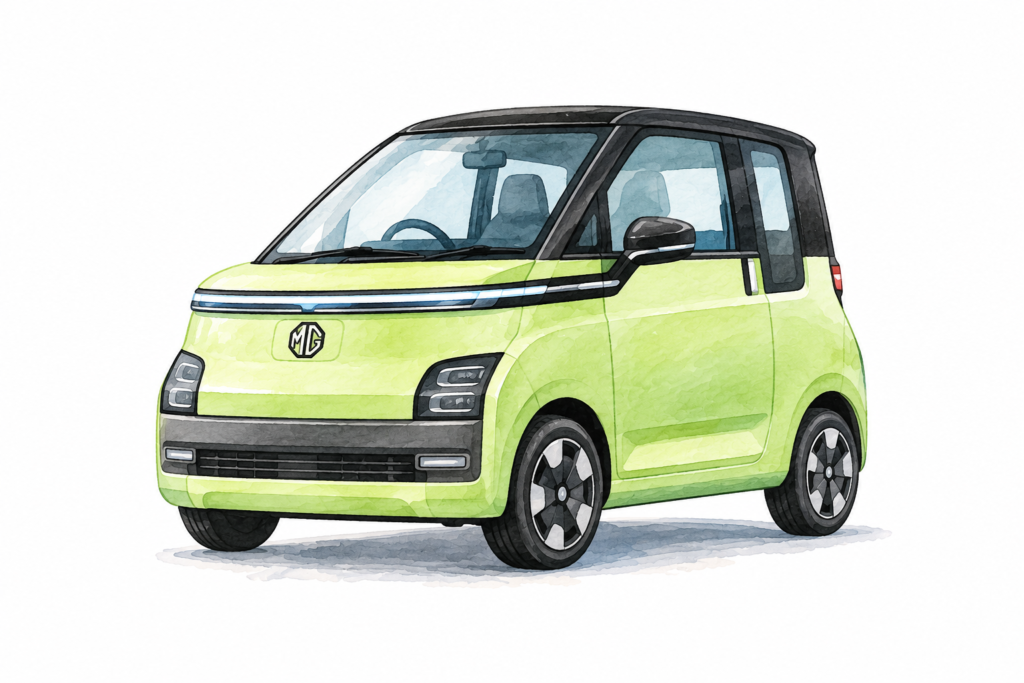
For a small electric car, the MG Comet raises a surprisingly big question: what does a buyer actually value in an urban EV? Is it range, technology, ease of ownership, or simply the ability to make city driving less cumbersome?
That makes the MG Comet price worth looking at beyond the usual specification sheet. The Comet is not trying to be an all-purpose family car. Its proposition is more specific: a compact, technology-led EV designed around the realities of crowded Indian cities.
At present, the Comet EV starts at ₹7.80 lakh ex-showroom and goes up to about ₹10.07 lakh depending on the variant. There is also a Battery-as-a-Service option, starting at ₹4.99 lakh plus ₹3.20 per km for the battery.
The more interesting question, therefore, is whether what you get for that money makes sense in everyday use.
Key Highlights
- The MG Comet price makes the EV particularly relevant for urban buyers looking for a compact, easy-to-drive city car.
- Its claimed 230 km range and connected technology make it suited to everyday city commuting.
- Features such as dual 10.25-inch screens, smartphone connectivity and i-Smart add meaningful tech value.
- The Comet shows how electric mobility can be made practical without focusing only on performance or battery size.
- MG’s wider journey reflects how established automotive brands can use heritage while continuing to evolve through technology and new mobility experiences.
The MG Comet Price Makes More Sense When You Look at Its Purpose
The Comet is deliberately different from the typical small hatchback. At under three metres long, with a 4.2-metre turning radius, it is built for environments where parking space is scarce and traffic is a daily negotiation. It seats four and uses a 17.4 kWh battery with a claimed 230 km range.
That positioning matters.
For someone driving 20–30 km a day around a city, a compact EV can offer something that a larger vehicle cannot: convenience. The Comet can fit into tighter spaces, is easy to manoeuvre and avoids the constant fuel-stop routine associated with conventional cars.
This is where the MG Comet price becomes less about size and more about use case. It is not necessarily the answer for a buyer looking for one car to handle every road trip. But as a city-focused second car, commuter vehicle or first EV, its proposition is considerably clearer.
Technology Is Part of the Comet’s Value
One of the more interesting things about the Comet is how much of its appeal comes from technology rather than outright performance.
Higher variants get a pair of 10.25-inch displays, wireless Android Auto and Apple CarPlay, along with i-Smart connected-car technology offering more than 55 connected features. Depending on the variant, buyers can also get a digital key, reverse camera and other connected functions.
This reflects a broader change in how automotive technology is being evaluated in India. Buyers increasingly expect their cars to behave more like connected consumer devices. Screens, smartphone integration, remote functions and software-led features are becoming part of the ownership experience rather than optional luxuries.
The Comet is particularly relevant here because it makes these features available in a very small package. That is important for the wider EV market in India: advanced technology becomes more meaningful when it solves ordinary problems rather than simply adding another item to a specification list.
What Does the Range Look Like in Real Life?
On paper, the Comet’s 230 km ARAI-certified range looks reassuring for city use. But real-world EV ownership is rarely about achieving the laboratory number.
MG’s own current product information places real-world range at around 170–200 km, depending on traffic, air-conditioning use and driving style.
For an urban commuter, that can still be more than sufficient.
Someone covering 25 km on an average weekday could potentially go several days between charges. The key is that the Comet’s range works best when matched with its intended environment. It is a city EV first, and treating it like a long-distance touring car misses the point.
Charging is also worth considering. The standard 3.3 kW setup takes around seven hours for a full charge, while the fast-charging variants can complete 0–100% in about 3.5 hours using a 7.4 kW AC charger. The Comet does not offer DC fast charging.
Again, context matters. An overnight home charge is a very different proposition from depending on public charging infrastructure every day.
When Heritage Has to Keep Moving
The interesting story behind the Comet is bigger than the car itself.
Morris Garages began in a garage in 1924, building its reputation around British sports cars, roadsters and a distinctly characterful approach to motoring. A century later, the brand describes itself as a “100-year-old start-up” — a useful way of expressing the tension between heritage and reinvention.
That tension matters for established automotive brands in India. Heritage can create recognition, but it can also become a trap if a company keeps selling yesterday’s identity to tomorrow’s customer.
The Comet takes a different route. There is very little nostalgia in its design or proposition. It is small, electric, connected and designed around urban practicality. In that sense, it represents the more difficult side of heritage: using the credibility accumulated over decades while still being willing to build products that could not have existed in the brand’s earlier eras.
That philosophy has also become more visible at the premium end.
The Bigger MG Story Is About Reinterpretation
The move from a compact city EV to products such as the Cyberster might initially seem difficult to connect. Strategically, however, there is a common thread.
The Cyberster takes the idea of the historic MGB Roadster and translates it into an electric performance car. Launched in India through MG SELECT in 2025, it combines that roadster lineage with a 510 PS dual-motor setup, 77 kWh battery and a claimed 580 km MIDC range.
That is a useful example of how heritage can work in modern automotive branding. The objective is not to recreate the past. It is to reinterpret something recognisable for a different generation.
The same thinking is visible in MG SELECT, the brand’s premium channel. Its Experience Centres were designed with a gallery-like approach, placing greater emphasis on curated environments and customer experience rather than the conventional dealership format.
That shift reflects a wider development in the luxury automotive market. Premium positioning is increasingly about what surrounds the product — discovery, design, personalisation and ownership experience — as much as the badge or hardware itself.
What the SAIC–JSW Partnership Changes
The next phase is equally important.
The SAIC–JSW partnership formed in 2023 with a stated focus on localisation, EV ecosystem development, charging infrastructure, manufacturing capacity and a broader product portfolio.
For MG Motor India, that creates an opportunity to move beyond being simply another imported-technology-led automotive player and build a deeper presence in India’s changing mobility ecosystem.
That distinction matters because India’s EV market is moving from early adopters toward a much broader customer base. Technology alone will not be enough. Buyers need products that fit their routines, ownership models that feel manageable, and brands they can trust to remain relevant as the market develops.
The Comet is an example of that approach at the accessible end: a small EV that makes technology and electric mobility approachable without pretending to be something it isn’t.
So, Is the MG Comet Good Value?
The answer depends on what you expect from it.
If your priority is highway touring, generous cabin space or one vehicle for every possible journey, there are better choices. But if the requirement is a compact urban EV with connected technology, easy manoeuvrability and enough real-world range for regular city use, the Comet starts to make a strong case.
The Morris Garages car price conversation has, in many ways, moved a long way from the company’s origins. Yet the underlying challenge remains familiar: make a car people actually want to live with.
That is perhaps the more useful way to assess the Comet. Not by asking whether it replaces every kind of car, but whether it solves a particular problem unusually well.
After 100 years, that may be what staying relevant in the automotive business really means — not preserving the past exactly as it was, but knowing what is worth carrying forward and what needs to change.
FAQs
What is the MG Comet price in India?
The MG Comet EV starts at around ₹7.80 lakh ex-showroom, with prices varying by variant and ownership option.
What is the real-world range of the MG Comet?
The claimed range is 230 km, while real-world range can be around 170–200 km depending on traffic, driving style, air-conditioning use and other conditions.
Is the MG Comet suitable for daily city driving?
Yes. Its compact dimensions, small turning radius and electric powertrain make it particularly well suited to everyday urban commuting.
What technology does the MG Comet offer?
Depending on the variant, the Comet offers features such as dual 10.25-inch screens, Apple CarPlay and Android Auto, connected-car technology, a digital key and reverse camera.
Does the MG Comet support fast charging?
Selected variants support 7.4 kW AC charging, while the Comet does not offer DC fast charging. The standard charging setup is better suited to overnight home charging.
Is the MG Comet a good value-for-money EV?
For buyers looking for a compact urban EV with modern technology and practical city range, it can offer strong value. Its suitability depends largely on whether its small size and city-focused character match your driving needs.