FII Selling, Global Tech Weakness Push Nifty Below 25,350
Indian equities closed lower on February 27, 2026. The Sensex fell by more than 500 points, while the Nifty slipped below 25,350 and moved near 25,300 during the session. The decline came as three risk factors aligned at the same time: continued foreign institutional selling, weakness in global technology shares, and higher geopolitical stress linked to Iran. Rupee pressure and lower risk appetite added to the move, and benchmark support remained limited despite selective gains.
Pressure broadens across realty, FMCG, and financial weights while early IT cushion loses force
Selling spread across sectors instead of staying in one segment. Realty, FMCG, and major financial names added to index drag. IT stocks showed some early resilience, but that support faded as broader de-risking strengthened through the day.
This indicates a wider market reduction in risk, not a narrow stock-specific move. Large private bank and telecom weakness amplified the fall, while gains in a few pockets were not enough to change the overall tone.
Weak starting structure in telecom and IT heavyweights makes the decline look cumulative, not only trigger-driven
The fall looked cumulative, not purely event-driven, because key telecom and IT heavyweights were already in weak technical shape before external stress increased. When major stabilising stocks are below key moving averages and momentum is soft, index downside usually becomes harder to absorb.
A counter-view remains: intraday holding near 25,300 and relatively better structure in some large domestic names suggest this could still be a short macro-driven reaction.
This view weakens if quick momentum repair does not appear in both the index and major laggards. A sustained close above 25,500, along with stronger closes in BHARTIARTL, INFY, and HCLTECH on higher-than-average volumes, would challenge the current de-risking reading.
Relative-structure matrix shows limited shock absorbers, with ICICIBANK and MARUTI holding better
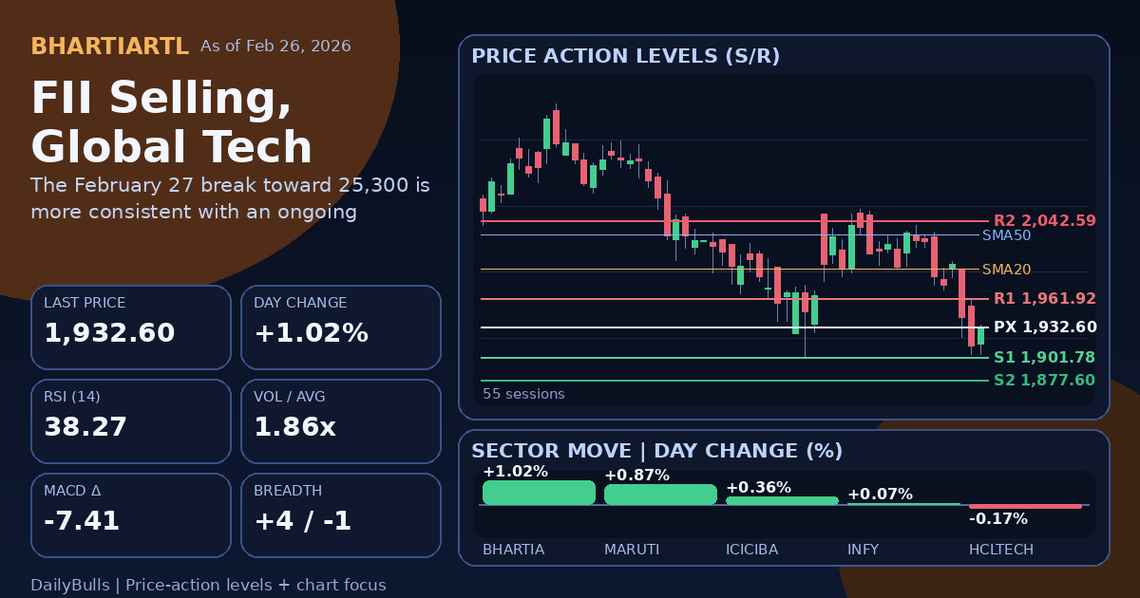
Technical snapshot as of close on February 26, 2026 (one session before the February 27 market move):
| Ticker | Price | Day change (%) | Average volume | RSI (14) | MACD line | MACD signal | Trend position |
|---|---|---|---|---|---|---|---|
| BHARTIARTL | 1932.60 | 1.02 | 5726883 | 38.27 | -19.9800 | -12.5730 | Below 20-day and 50-day moving averages |
| ICICIBANK | 1404.90 | 0.36 | 13043945 | 53.52 | 4.5468 | 5.6853 | Above 20-day and 50-day moving averages |
| INFY | 1291.00 | 0.07 | 20161141 | 20.42 | -81.9805 | -69.4241 | Below 20-day and 50-day moving averages |
| HCLTECH | 1373.50 | -0.17 | 3974162 | 25.42 | -72.7002 | -58.1418 | Below 20-day and 50-day moving averages |
| MARUTI | 15201.00 | 0.87 | 273185 | 49.01 | -137.9981 | -192.4374 | Above 20-day but below 50-day moving average |
The matrix indicates limited shock absorbers. ICICIBANK and MARUTI show relatively better trend and momentum balance. INFY, HCLTECH, and BHARTIARTL remain weaker on momentum and trend placement. Volume signals are mixed: ICICIBANK and BHARTIARTL traded above average volume, while INFY and HCLTECH stayed below average, which reduces confidence in immediate stabilisation from those names.
Evidence remains bounded by intraday prints, with 25,300 holding behavior and mixed leadership
The reading remains provisional because it is based on intraday behaviour. Nifty holding around 25,300 during pressure shows support did emerge, and leadership was not uniformly weak across all heavyweight groups.
There was no single dominant large-cap corporate disclosure that explained the entire move. The decline is better classified as a broader market risk episode with mixed internal resistance.
Cross-source synthesis points to external-risk de-risking interacting with fragile internal structure
The combined evidence points to external-risk de-risking as the main driver, with larger impact due to weak internal setup in several telecom and IT heavyweights. Broader weakness across realty, FMCG, and key financial names supports this classification.
At the same time, uncertainty remains because intraday support near 25,300 and stronger relative structure in select domestic leaders show the downside was significant but not fully one-directional.
Share this insight
Spread the Alpha
Related Articles
More ideas that align with your trading playbook.

Stocks to Watch Tomorrow in India if Global Gas Risk Cools
Stocks to watch tomorrow in India if global gas risk cools If global gas-risk premium softens overnight, Indian equities may react through…
India Market Stress Playbook: Oil, Rupee, VIX, Gas and Banks
India Market Stress Playbook: Oil, Rupee, VIX, Gas and Banks This hub connects our recent India market coverage into one working framework.…
Bank Nifty Fall: Liquidity Stress or Earnings Reset?
Bank stocks led the downside in a high-volatility session. The move was sharp, but classification is important. For next-session sector confirmation, see…