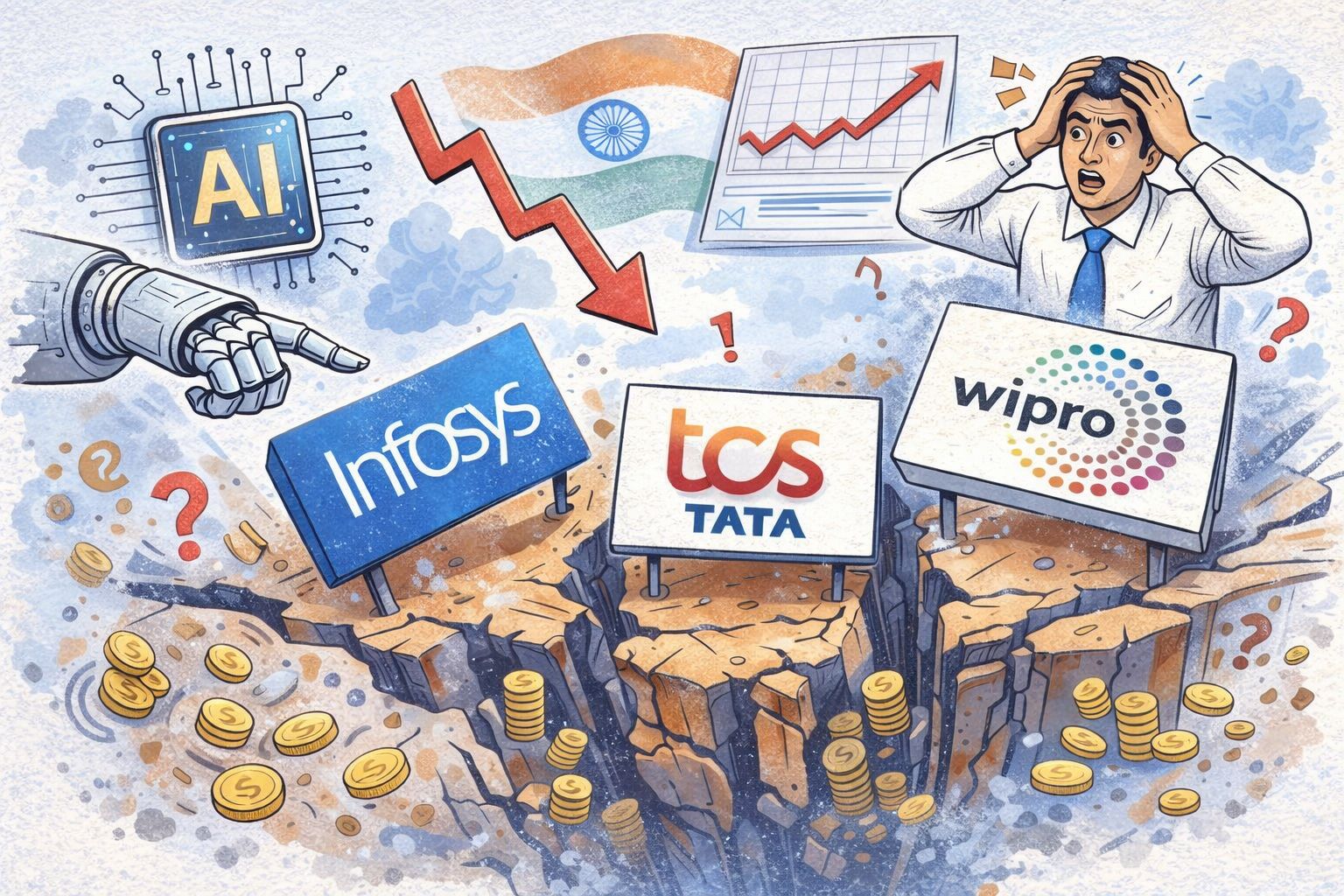
Why Indian IT Stocks Are Really Falling: Beyond the AI Fear Story
The Indian IT sector is going through a sharp correction. While news headlines blame “AI fears,” a deeper look at the data and market trends reveals multiple underlying causes that are driving this sell-off.
The Numbers Tell the Story
The fall in IT stocks has been severe and prolonged. The Nifty IT index is currently trading at 35,073, down 17.6% over the past year, while the broader Nifty 50 has gained during the same period. In just the last seven trading sessions ending February 11, 2026, the IT index fell 13%, wiping out over ₹1.3 lakh crore in market value.
Looking at individual stocks, the damage is clear:
| Company | Current Price | PE Ratio | 2-Year Fall | Market Cap | 52-Week High |
|---|---|---|---|---|---|
| TCS | ₹2,909 | 20.57 | -32% | ₹10.53 lakh cr | ₹4,052 |
| Infosys | ₹1,471 | 20.72 | -17% | ₹5.96 lakh cr | ₹2,150 |
| Wipro | ₹229 | 18.15 | -13% | ₹2.41 lakh cr | ₹352 |
| HCL Tech | ₹1,551 | 25.56 | -18% | ₹4.21 lakh cr | ₹1,860 |
| Tech Mahindra | ₹1,641 | 34.83 | -28% | ₹1.60 lakh cr | ₹2,310 |
On February 11 alone, TCS fell 4.58%, Infosys dropped 5.18%, HCL Tech declined 4.55%, and Wipro lost over 4%.
What Is Actually Happening
The Immediate Trigger: Global AI Platform Threat
The recent sharp fall was triggered by comments from global AI platform companies, particularly Palantir, which stated that its AI platform could replace multiple enterprise software products and reduce the need for third-party implementation services. This directly threatens the business model of Indian IT companies, which earn significant revenue from implementing and maintaining enterprise software systems.
However, this is only the surface story. Multiple deeper issues have been building for over a year.
The Real Issue: Business Is Growing Too Slowly
Indian IT companies are not facing a collapse in earnings. In fact, their Q3 FY25 results showed modest revenue growth of around 1.1% quarter-on-quarter and 9% profit growth year-on-year. TCS reported revenue of ₹67,087 crore and profit of ₹10,720 crore in its latest quarter, while Infosys posted revenue of ₹45,479 crore and profit of ₹6,666 crore.
The problem is that this growth rate is too low for the valuations these stocks once commanded. For the past 15 years, Indian IT companies were seen as steady 10-15% growth businesses. Now, with growth slowing to mid-single digits, the market is reducing the price-to-earnings multiples it is willing to pay.
The Nifty IT index currently trades at a PE ratio of 25.4. Many analysts believe this is still too high for companies growing at 4-6% annually, especially when compared to other sectors of the Indian economy that are showing stronger growth.
Problem 1: Weak Global Spending on IT Services
Even before AI concerns became prominent, Indian IT companies were reporting weak demand from their largest clients in the United States and Europe. High interest rates, economic uncertainty, and election-related caution in 2024-2025 led many companies to delay or reduce spending on IT transformation projects.
This meant that while “run-the-business” work continued, the high-margin “change-the-business” projects slowed down significantly. Since discretionary transformation projects are where Indian IT firms earn better margins, this shift hurt both growth and profitability expectations.
Problem 2: AI Is Reducing the Amount of Work Needed
This is the less-discussed but more serious structural concern. AI tools are making software development, testing, and support work significantly more productive. A developer using AI coding assistants can write code 30-50% faster. Automated testing tools can replace manual testers. AI chatbots can handle customer support queries that previously needed human agents.
This creates what analysts call “AI deflation” – clients need fewer hours of work to achieve the same business outcome. Even when Indian IT companies win new projects, the total billing hours and revenue per project may be lower than in the past because AI tools have made the work more efficient.
For a business model built on billing clients for the number of hours worked, this is a fundamental challenge. Companies may need to shift to value-based pricing instead of time-and-materials contracts, which could reduce margins.
Problem 3: Clients Are Building Their Own Tech Teams in India
Another major trend is the rapid growth of Global Capability Centers (GCCs) – captive technology centers that multinational companies are setting up in India to do their own IT work. Instead of outsourcing work to TCS or Infosys, companies like JPMorgan, Walmart, and Google are hiring thousands of engineers directly in Indian cities.
This not only takes away potential revenue from Indian IT firms but also creates competition for talent, driving up wage costs. The recent Union Budget even simplified tax rules for GCCs, making it easier for foreign companies to expand their own centers in India.
Problem 4: Cloud Companies Are Taking Over More Work
The rise of cloud platforms like Amazon Web Services (AWS), Microsoft Azure, and Google Cloud has also shifted the value equation. These platforms now offer managed services, pre-built templates, and automation tools that reduce the need for third-party integration and maintenance work.
For example, if a company wants to move its applications to the cloud, AWS now provides tools and services that make the migration faster and cheaper than hiring a traditional IT services firm. This squeezes the addressable market for Indian IT companies.
Problem 5: Foreign Investors Are Selling
Foreign institutional investors (FIIs) have been heavy sellers of Indian IT stocks. In early 2025, FIIs pulled out about ₹1.35 trillion from Indian equities, with IT stocks among the hardest hit.
At the same time, domestic investors have been rotating their money into sectors that benefit from India’s domestic growth story – banks, infrastructure, manufacturing, and consumer goods. These sectors have outperformed IT significantly over the past year, making IT stocks less attractive on a relative basis.
The Earnings Quality Question
While IT companies have maintained reasonable profit margins, there are concerns about the quality of these earnings. For instance, TCS reported strong deal wins in recent quarters, with total contract value (TCV) exceeding $10 billion in some quarters. However, revenue growth has not matched the deal wins, raising questions about pricing pressure and project delays.
Several IT companies have also increased their spending on employee training to build AI skills. TCS alone is training over 100,000 employees in AI-related technologies. While this is necessary for the future, it adds to costs in the short term without immediate revenue benefits.
What Management Is Saying vs. What the Market Believes
IT company managements remain optimistic in their public statements. They point to growing pipelines of AI projects, strong client relationships, and the digital transformation opportunity that still lies ahead.
However, the market is more skeptical. Investors are concerned that:
- AI projects may replace existing revenue faster than they create new revenue
- The profit margins on AI work may be lower than traditional outsourcing
- Platform companies and cloud providers will capture most of the value from AI, leaving less for implementation partners
- The shift from time-based to value-based pricing will reduce overall billing
This disconnect between management optimism and investor skepticism is keeping pressure on stock prices even when quarterly results meet expectations.
Policy Changes and Their Impact
The Union Budget 2025 introduced some changes that have mixed implications for IT companies. The government simplified tax rules for GCCs, making it easier for foreign companies to set up their own centers in India. While this supports India’s position as a global technology hub, it also increases competition for traditional IT service providers.
Additionally, tax holidays for data centers aim to attract global AI and cloud infrastructure to India. This could benefit the overall digital ecosystem but may channel more value to infrastructure and platform providers rather than traditional IT services firms.
The Valuation Reset
What we are witnessing is essentially a valuation reset. For years, Indian IT stocks traded at premium multiples because they offered predictable growth, strong cash flows, and resilient business models. Now, as growth slows and business model risks emerge, the market is repricing these stocks at lower multiples.
The median PE ratio of IT stocks in the Nifty IT index is around 26, which is still not cheap for companies growing at 4-6% annually. Analysts estimate that if growth remains in single digits and margin pressure continues, fair PE ratios could be closer to 18-20, suggesting further downside potential.
What Investors Should Watch
If you are tracking IT stocks, here are the key factors to monitor going forward:
- Earnings revisions: Are analysts continuing to cut earnings estimates for FY27 and FY28, or are expectations stabilizing?
- Deal pricing and AI clauses: In management commentary, listen for mentions of “productivity sharing” or “AI-driven efficiency clauses” in contracts, which could indicate pricing pressure.
- Revenue mix: Companies that increase their share of consulting, platform work, and product revenue (versus traditional application development and maintenance) may perform better.
- Client concentration: Watch whether large clients are reducing their spending or shifting more work to GCCs and direct cloud providers.
- Margin trends: If operating margins start declining quarter after quarter, it would confirm that AI deflation and pricing pressure are real problems.
- Valuation levels: If PE ratios fall to 18-20 while earnings stabilize, it could create a contrarian buying opportunity for long-term investors.
The Bottom Line
The fall in Indian IT stocks is not just about AI fear. It is driven by a combination of:
- Slower revenue growth that does not justify previous valuations
- Weak discretionary IT spending from global clients
- Structural pressure on the time-and-materials business model from AI automation
- Competition from GCCs and cloud platform providers
- Foreign investor selling and rotation into domestic-focused sectors
- A business model that is being fundamentally challenged by technology changes
The “AI fear” narrative is convenient and easy to understand, but the reality is more complex. The Indian IT sector is facing both cyclical weakness and structural challenges that will require significant business model adaptation over the next few years.
For investors, this is not a situation where stocks will bounce back quickly to previous highs. The sector needs to prove that it can grow revenue and margins in a world where AI is changing how technology services are delivered and priced. Until that clarity emerges, volatility and pressure on valuations are likely to continue.
Share this insight
Spread the Alpha
Related Articles
More ideas that align with your trading playbook.

Why Indian Chemical sector in declining and what to expect for future?
Despite a strong position in global markets, the Indian Chemical sector has shown timid growth since the year 2022. The industry was…

Best Sugar Ethanol Stocks by production capacity
The ambitious goal of the Modi Government to transform the sugarcane belt in India as the energy belt, received a positive response…

 DailyBulls (Arthashilpi Ventures) is a D-U-N-S verified company.

Very interesting points you have mentioned, thanks for posting.