Nifty Slides on Tariff-Iran Jitters; Banks, FMCG Weigh
13:02 IST prints show risk-off broadening across benchmark indices
At 13:02 IST, benchmark prints showed a broader risk-off move. Sensex was lower by about 636 points and Nifty was lower by about 218 points. Nifty also slipped below 25,350 during the same stretch.
The weakness was not limited to opening volatility and stayed visible through midday trade. The backdrop remained negative, with overnight selling in US technology shares, uncertainty around tariff direction, and fresh geopolitical stress linked to Iran. With these cues together, domestic indices stayed under pressure instead of building a sustained rebound in the first half, and market breadth remained weak across sectors.
Bank and FMCG heavyweights decline together and intensify index drag
The downside was concentrated in two heavyweight groups at the same time: banks and financials, and FMCG. Key drags included HDFCBANK, ICICIBANK and SBIN among financials, along with HINDUNILVR in FMCG.
These stocks carry high benchmark weights, so their decline quickly translated into index-point losses even before broader participation from mid-sized stocks. Intraday moves below 25,400 and then below 25,350 reflected this weight effect. When both groups weaken together, the benchmark can fall faster than in a single-sector decline, especially when global risk sentiment is fragile.
Defensive and financial selling align with a de-risking pulse, not a clean style handoff
The session pattern matched broad risk reduction more than a clean style rotation. In a typical rotation, defensive FMCG often attracts flows when financials weaken. In this session, both heavyweight groups came under pressure while macro headline stress stayed elevated.
A valid counter-view is that month-end positioning and book-cleaning created short-lived cross-sector selling that can reverse quickly.
This de-risking interpretation weakens if the next two sessions show sustained leadership returning to banks or FMCG, with Nifty reclaiming and holding above 25,400 on improving breadth despite no meaningful easing in external risk headlines.
Trend-and-momentum matrix shows mixed starting structure but shared pressure in lagging groups
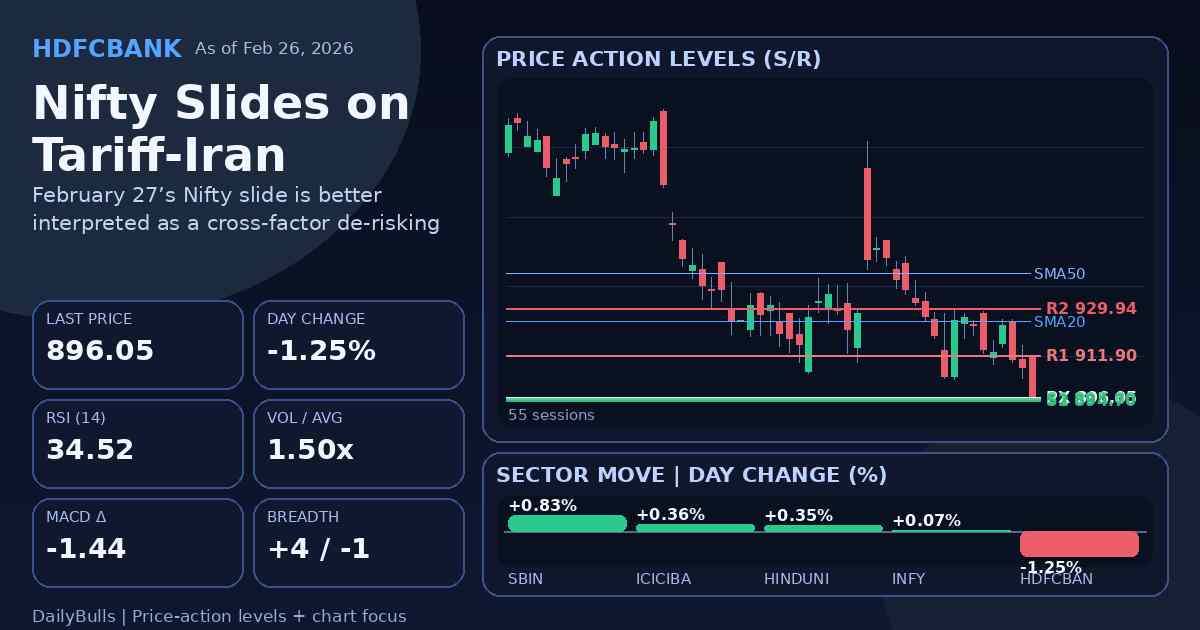
Technical snapshot is based on the close of February 26, 2026. The index decline discussed above occurred in the next session.
| Ticker | Price | Day Change (%) | Average Volume | RSI (14) | MACD Line | MACD Signal | 20-day SMA | 50-day SMA | Trend Position |
|---|---|---|---|---|---|---|---|---|---|
| SBIN | 1209.50 | 0.83 | 14408573 | 68.00 | 46.5946 | 47.0778 | 1155.48 | 1069.34 | Above both 20-day and 50-day moving averages |
| ICICIBANK | 1404.90 | 0.36 | 13043945 | 53.52 | 4.5468 | 5.6853 | 1397.03 | 1384.49 | Above both 20-day and 50-day moving averages |
| HINDUNILVR | 2383.30 | 0.35 | 1500716 | 53.37 | -5.2802 | -6.6984 | 2364.88 | 2357.39 | Above both 20-day and 50-day moving averages |
| INFY | 1291.00 | 0.07 | 20161141 | 20.42 | -81.9805 | -69.4241 | 1437.99 | 1560.05 | Below both 20-day and 50-day moving averages |
| HDFCBANK | 896.05 | -1.25 | 26999150 | 34.52 | -9.9336 | -8.4899 | 925.21 | 943.57 | Below both 20-day and 50-day moving averages |
The starting setup was mixed. Three stocks were above both moving averages, while HDFCBANK and INFY were below both. Momentum was also uneven, with weaker RSI in HDFCBANK and especially INFY, even as IT remained relatively firm intraday. This contrast suggests intraday risk mood overrode pre-session technical differences, while banks and FMCG still drove most of the benchmark drag.
Month-end positioning and GDP-event proximity keep persistence uncertain
The current evidence reflects observed market behaviour, not proof that the move will persist. The session showed broad weakness with concentrated drag from banks and FMCG, but month-end positioning and proximity to GDP data can increase short-term volatility and then fade.
This leaves room for an alternative reading where the move is temporary positioning noise rather than a broader shift in risk behaviour. The de-risking view remains conditional and weakens if leadership in banks and FMCG returns with a durable hold above 25,400 and stronger market breadth.
Cross-source evidence supports a macro-stress interpretation of today’s tape
The evidence remains aligned for now: a clear midday benchmark drawdown, heavyweight drag from banks and FMCG, and a mixed pre-session technical base that did not prevent broad pressure. Relative firmness in IT during the decline supports the view of macro-stress-driven risk reduction across high-impact groups, rather than a simple sector rotation.
This interpretation remains conditional and depends on near-term changes in leadership and market breadth.
Share this insight
Spread the Alpha
Related Articles
More ideas that align with your trading playbook.

Reliance AGM 2026 Highlights: Jio IPO, AI and New Energy Plans Explained
Reliance Industries’ annual general meetings usually come with big announcements. The 2026 AGM was no different. But beneath the new products, ambitious…
SEBI’s Commodity Plan Just Lost Its Institutional Anchor. What It Means for MCX
SEBI wanted banks, insurers, and eventually pension funds to deepen India's commodity derivatives market. RBI and IRDAI are not inclined to allow…

India’s Data Center Power Trade: Which Stocks Benefit First if AI Infra Spending Accelerates?
India's AI buildout may look like a software story, but the first listed winners could emerge from transformers, cables, switchgear, backup power,…

 DailyBulls (Arthashilpi Ventures) is a D-U-N-S verified company.