
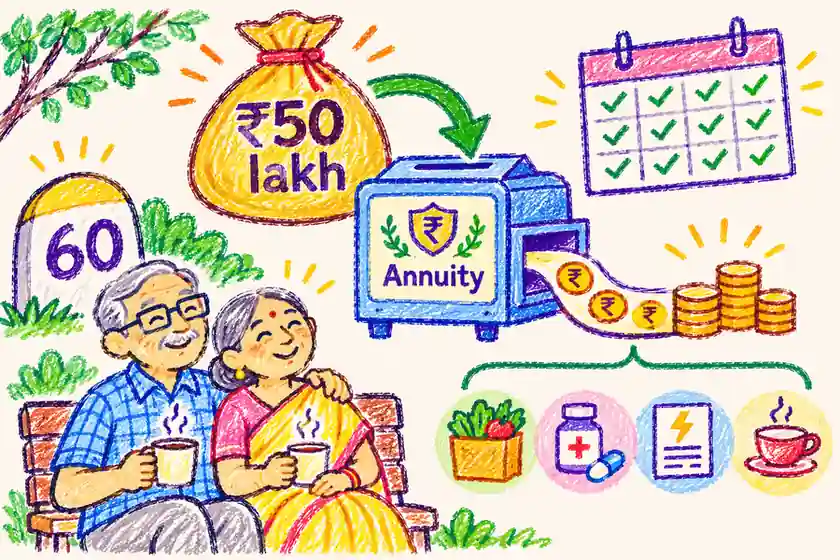
You turn 60 in September. The plot you’ve held for twenty years finally sells, and ₹50 lakh sits in your account. A bank manager calls twice that week, all enthusiasm. Your spouse writes one question on the back of an electricity bill: “How much comes in every month?” The scenario is invented. The question isn’t.
What Does ₹50 Lakh Pay Each Month?
You do the sum on your phone that evening. Amount, times a rate, divided by 12. At an assumed 6%, ₹25,000. At 6.5%, ₹27,083. At 7%, ₹29,167. None of these is a quote. Rates move with the insurer, the age and the option picked, and they don’t stay still for long. A written quote is the only real number.
Why Did Three Offers For The Same Money Look So Different?
Because the manager kept saying “annuity” as if it were one thing. It isn’t. In our made-up version, the life-only plan offers 7%, so ₹29,167. The one that returns the ₹50 lakh to a nominee offers 6%, so ₹25,000. The joint plan that keeps paying your spouse sits in the middle at 6.5%, so ₹27,083. The rates are invented, but the pattern is typical: the more an insurer promises to continue or give back, the less it pays today.
You study the gap. ₹4,167 a month, ₹50,000 a year, so that your children get the ₹50 lakh back someday. “We’ll sort that on Sunday,” your spouse says, and puts the bill in the drawer.
How Long Before The ₹50 Lakh Comes Back To You?
Your neighbor, a retired accountant, asks this the moment you tell him. With the life-only figure, ₹29,167 a month is ₹3.5 lakh a year. Divide ₹50 lakh by that and you get a little over 14 years, so you’d be about 74 when the payouts match what you paid. After that, every month is extra. If you live to 90, you’d receive about ₹1.05 crore in total, twice what you put in. The sum ignores tax and rising prices, so it flatters the annuity a little. But it explains why people with long-lived parents tend to lean toward it.
Will ₹29,167 Still Feel Like ₹29,167 Later?
Your sister-in-law raises this one, over tea. A fixed payout doesn’t grow, and prices do. At an assumed 6% a year, ten years on that ₹29,167 buys what about ₹16,300 buys today. Fifteen years on, it’s more like ₹12,200. The money arrives on time, every month. It just stretches less each year.
The alternative you look at: keep the ₹50 lakh invested and draw 4% a year. That starts at ₹16,667 a month. No guarantee there. But the money would still be yours, and it might grow. You can’t say yet which you prefer.
How Do You Get Your Own Number?
That night you try an annuity calculator on your laptop, type in your age and ₹50 lakh, and get a figure in seconds. Then you repeat it for joint life, and again for the return-of-price version. Three results, side by side on a sheet of paper. A screen estimate isn’t an offer, of course. The actual figure has to come from the insurer.
What Are You Actually Buying?
Your son, home for the weekend, calls it an exchange. The annuity definition, as he puts it over breakfast: you give the insurer a lump sum once, and they send income for life or a set number of years. The lump sum doesn’t come back. Then he lists the details on his fingers. Which option. Whether it keeps going for Mom. Whether anything comes back to us. Typically you can’t change that choice after the policy is issued, so read the options twice.
Should You Wait For Better Rates?
A colleague from your old office says rates will go up next year, so why hurry? Maybe. Annuity rates follow market yields, and nobody can predict those well. Waiting a year could help or hurt, and during that year ₹50 lakh sits in a savings account earning less than you’d get from deposits. One option is to split the purchase: half now, half in twelve months. That spreads the timing risk, though the second half will be bought at a year older, which usually raises the rate a little.
Who Should Not Put All ₹50 Lakh Into It?
Someone with no emergency money. Someone whose spouse has no income of their own and would need the payout to carry on after they’re gone. And someone who picks the life-only option because it pays most, then remembers the children. Splitting is an option: ₹30 lakh to the annuity, ₹20 lakh kept flexible.
What Should You Do Before Signing?
Ask for two quotes on paper. At the second insurer, ask what happens if you die in year one, and then year ten, and note whether the agent has to look it up. Have your spouse check what they’d receive, down to the rupee. Someone will say the rate drops next week. Chances are it won’t, and you’ll have waited seven days anyway.
On Sunday you go with the joint option for ₹30 lakh and keep ₹20 lakh where you can reach it. You mention the ₹1,250 a month you give up versus life-only. Your spouse says they will sleep better. That decides it.