
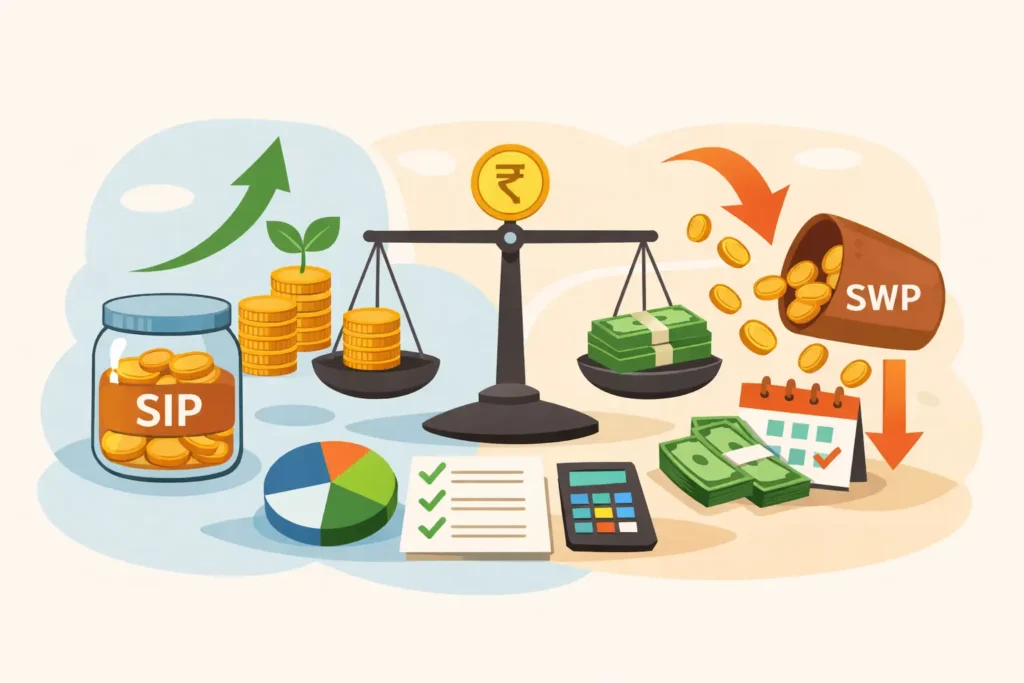
What do you expect in the long term when you invest in the market?
Most investors would say they want a decent corpus and enough wealth to retire peacefully. However, financial success isn’t just limited to growing your wealth. It also involves learning how to withdraw the wealth that you accumulate over the years – wisely. Therefore, wealth utility deserves as much attention as wealth creation, particularly when your life goals evolve.
That’s where both SIPs and SWPs come into the equation. In this blog, we have explained how you can create a well-balanced financial plan where you can actually use your wealth wisely.
What Is an SIP and How Does It Support Long-Term Growth?
With an SIP, investors enjoy the simplest way to start accumulating wealth. You can choose any amount you are comfortable with and automate your contributions. Over time, the power of compounding does most of the heavy lifting.
Since you continue to invest regularly regardless of market fluctuations, SIPs average your buying cost of the units. Even during volatility, you must stay disciplined to maintain the continuity of compounding. There’s no worry about timing your investments, either.
SIPs are flexible indeed. You can increase, pause, or change your plan as your life evolves. Most investors use an SIP calculator to plan for their long-term goals.
What Is an SWP and Why It Matters for Post-Investment Planning?
An SWP (Systematic Withdrawal Plan) comes in when you have accumulated sizable wealth and want to withdraw the money at fixed intervals.
Once your investment journey shifts from building wealth to managing expenses, SWPs become incredibly helpful. These schemes help you withdraw a predictable income each month without selling the entire investment all at once. Therefore, the remaining balance still remains invested and continues to compound your wealth.
With SWPs, you can choose how much and how often you want to withdraw your funds. This approach gives you better control over your cash flow. Investors often use an SWP calculator to determine how much they can safely withdraw from their corpus without exhausting the capital they have built over the years through SIPs.
Why SIP and SWP Form a Complete Financial Lifecycle Strategy
If you’re just getting started with financial investments or are already investing in mutual funds, knowing how SIPs and SWPs work can help you plan your future better.
With SIPs, you build wealth for different goals like buying a house, funding your kids’ education, or building your retirement corpus. It’s all about building your financial independence.
Once you approach these goals, SWPs help you use this wealth responsibly from a predictable standpoint. It gives you a structured approach to use your money. This involves avoiding panic selling, preserving your capital, and extending the life of your investments.
When both these strategies work together, you can grow your wealth, preserve it, and withdraw only what you need while the rest keeps compounding. A comprehensive SIP and SWP planning supports investors at every age.
How to Structure SIPs Based on Goals, Risk Appetite, and Time Horizon
In the first place, you must be clear about your investment goals. Accordingly, you need to structure your SIPs.
Short-term goals
Short-term goals like planning a vacation or building an emergency fund usually require you to invest in conservative debt or hybrid funds.
Long-term goals
When you think about long-term goals like buying a house or retirement, creating SIPs in equity funds is a practical approach, considering their higher growth potential.
Time horizon
While investing, bring your risk tolerance and expectations into the equation. A person comfortable with reasonable volatility may be inclined towards equities. On the contrary, a conservative investor may prefer hybrid funds.
The most crucial priority is to start your SIPs as early as possible since your wealth gets more time to compound over the years. Also, with a growth in income, try to increase your SIP amount. During market dips, avoid stopping your SIPs and try to put in a lump sum amount to benefit from rupee-cost averaging.
How to Plan SWPs for Smooth and Sustainable Cash Flow
Once you have built a sizable corpus, it’s time to plan how you want to withdraw the amount based on your monthly or quarterly needs.
Here’s an important aspect for investors to note. When you accumulate wealth at a younger age, your risk tolerance is relatively high. However, as you cross the age of 45 or near your retirement, you may review your risk tolerance and move a part of your portfolio to debt or hybrid funds.
Next, the key is to choose a withdrawal amount that won’t exhaust your investment, or at least preserve it to support you for your lifetime. So, avoid unplanned withdrawals, or don’t withdraw large amounts during sharp market corrections.
A thoughtful and balanced approach with SWPs can help you build a dependable stream of income for various long-term goals.
Example
Let’s assume that you start investing in an equity mutual fund through a monthly SIP of INR 10,000. Considering the interest rate of 12% and the investment tenure of 20 years, you will accumulate a corpus of around INR 1 crore.
Now, if you create an SWP after moving this corpus to a balanced hybrid fund delivering a 10% annual return and continue to withdraw a monthly sum of INR 70,000 for the next 30 years, your corpus will generate the wealth needed. Most importantly, at the end of the 30th year, you will have a residual corpus of around INR 3.88 crore to fund you for the rest of your life.
Conclusion
SIPs help you build wealth gradually, while SWPs help you use that wealth wisely. Together, you get a balanced approach to financial planning that helps you manage your money. Long-term discipline with SIPs, along with structured withdrawals, will help you build financial resilience for your lifetime.


