Oil Spike and Weak Breadth Keep India Equities Under Pressure
Cross-Asset Stress Opens the Session
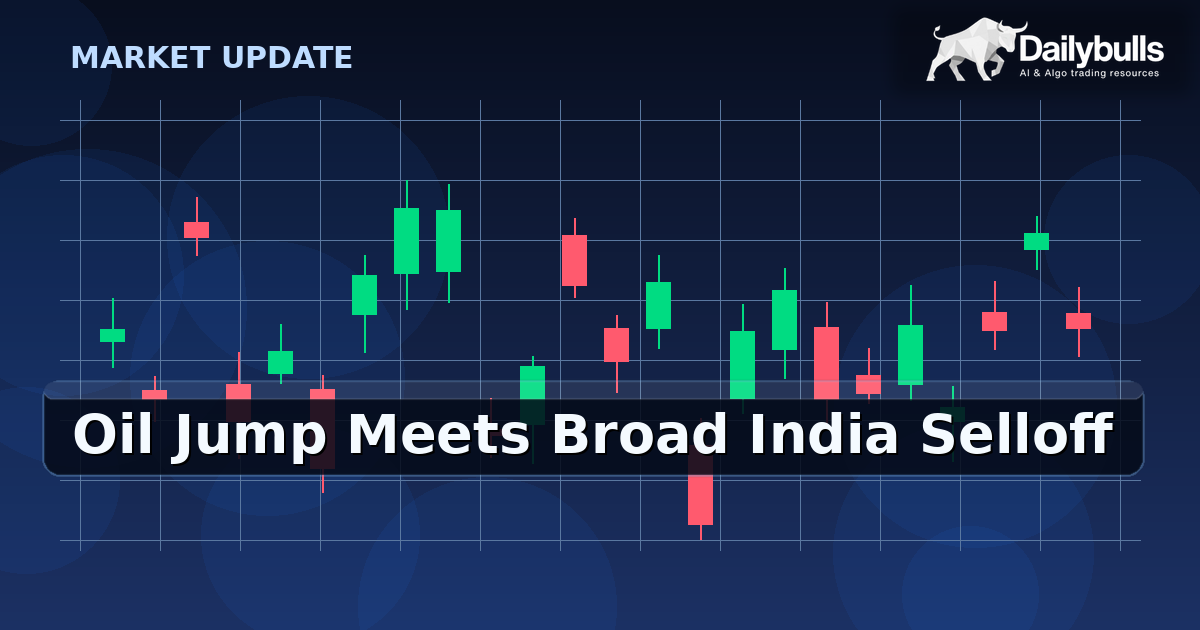
Indian equities traded in a broad risk-off tone in the latest snapshot, with Nifty down -1.44% and Sensex down -1.12%. At the same time, Brent crude rose 3.32% and WTI gained 3.13%, creating a clear cross-asset split between higher energy prices and weaker domestic equity benchmarks.
This combination matters because it captures both external pressure and local market response in one frame, instead of treating each move as an isolated headline.
Where the Pressure Sat Inside India
The internal sector map remained weak even though one pocket stayed marginally positive. Sector breadth stood at 1 positive sector versus 7 negative sectors, which is a narrow participation profile rather than a broad rebound profile.
Within that weak breadth, metals and realty remained the deepest drags at -4.06% and -3.45%, respectively, while auto also stayed under pressure at -2.66%. IT was the only tracked sector in positive territory at +0.21%, which was not enough to offset weakness across the rest of the board.
When the laggard cluster stays concentrated in cyclical and rate-sensitive pockets, index weakness tends to look structural for the session rather than random intraday noise.
Why the Move Looks Like Transmission, Not Noise
The broad setup is consistent with a transmission pattern in which external risk signals and domestic breadth weakness align. Rising crude can lift macro uncertainty and cost concerns, while weak breadth indicates that selling pressure is not confined to one corner of the market.
This does not prove a single cause for every market move. But the concurrent direction across crude, benchmarks, and sector breadth supports an evidence-based inference that risk appetite remained selective and fragile in this window.
Additional global proxies in the same snapshot reinforced that tone: US benchmark indices were negative and the dollar index remained firm. That broader context keeps the India move from being interpreted as a standalone anomaly.
What Makes This Different From the Earlier Heatmap
Earlier coverage in the 48-hour window focused on sector dispersion by itself. The current story adds a broader transmission layer by combining domestic breadth and sector hierarchy with cross-asset moves in crude and global risk proxies.
That incremental framing is important for duplicate discipline. A small decimal refresh in sector numbers alone would not be publication-worthy, but a persistent domestic weakness profile alongside a fresh energy jump and synchronized global risk tone clears the materiality bar for a new general-market note.
In other words, the key change is not only which sector moved but what market state those moves are occurring inside.
Near-Term Context for Follow-Through
For session-to-session interpretation, the most informative signals are whether breadth improves from the current 1/7 split, whether metals and realty remain the deepest laggards, and whether crude momentum cools or extends from current levels.
If breadth broadens materially while laggard concentration eases, the market may shift from stress transmission toward stabilization. If breadth remains narrow and laggard concentration persists while external risk proxies stay elevated, the present weak-structure read remains intact.
A second layer to monitor is persistence. One weak session can still be noise, but repeated weak breadth with the same laggard stack usually signals that pressure is not rotating out quickly. If IT remains the sole positive pocket while cyclical sectors continue to underperform, the internal profile stays fragile even if headline index declines slow down.
This framework is informational and evidence-led. It is designed to map current conditions clearly without making directional or personalized investment calls.
Share this insight
Spread the Alpha
Related Articles
More ideas that align with your trading playbook.

Reliance AGM 2026 Highlights: Jio IPO, AI and New Energy Plans Explained
Reliance Industries’ annual general meetings usually come with big announcements. The 2026 AGM was no different. But beneath the new products, ambitious…
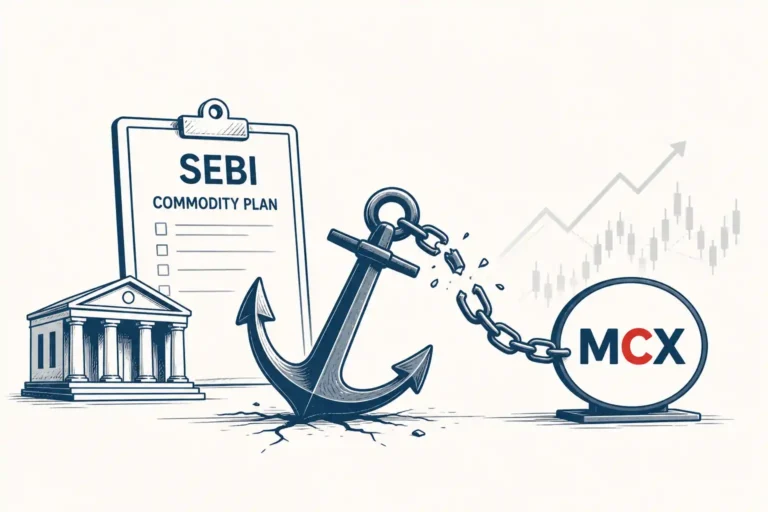
SEBI’s Commodity Plan Just Lost Its Institutional Anchor. What It Means for MCX
SEBI wanted banks, insurers, and eventually pension funds to deepen India's commodity derivatives market. RBI and IRDAI are not inclined to allow…

India’s Data Center Power Trade: Which Stocks Benefit First if AI Infra Spending Accelerates?
India's AI buildout may look like a software story, but the first listed winners could emerge from transformers, cables, switchgear, backup power,…
 DailyBulls (Arthashilpi Ventures) is a D-U-N-S verified company.